
Interactive Walking Calorie Calculator
Calculate exact calories burned based on your body weight, walking pace, and duration.
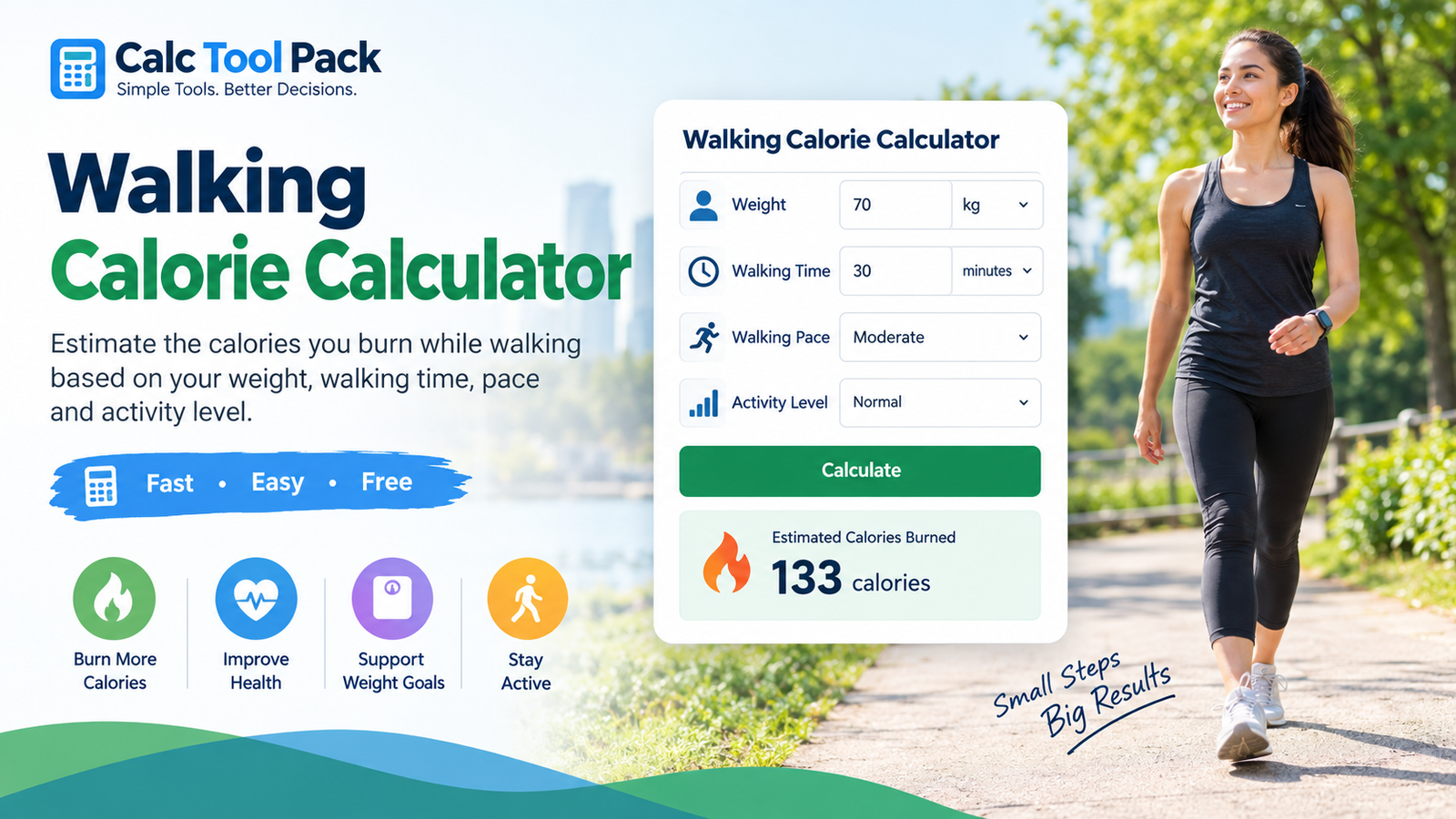
Walking Calorie Calculator
Walking is one of the easiest ways to add more physical activity to your daily routine. Whether you take a short walk after lunch, walk for fitness, use a treadmill, or enjoy a longer outdoor walk, you may want to know how many calories you burn.
Our Walking Calorie Calculator helps estimate the calories you may burn while walking. It uses information such as your body weight, walking time, pace, and activity level to provide a practical estimate.
The result is not an exact measurement. Your actual calorie burn can vary based on your body, walking speed, terrain, incline, and other factors. Still, a calorie estimate can be useful for tracking your activity and understanding how walking fits into your daily routine.
For more health and fitness tools, visit the Calc Tool Pack Health Calculators.
What Is a Walking Calorie Calculator?
A Walking Calorie Calculator is an online tool that estimates how many calories you may burn during a walking session.
The calculator can consider several factors, including:
- Body weight
- Walking duration
- Walking pace
- Activity intensity
- Distance
- Incline or terrain
A person who walks slowly for 30 minutes will not necessarily burn the same number of calories as someone who walks quickly for 30 minutes. Body weight can also affect the amount of energy used during the activity.
The purpose of a walking calorie calculator is to give you a useful estimate based on the information you provide.
What Does a Walking Calorie Calculator Calculate?
The calculator estimates the energy you may use while walking.
For example, you can enter your body weight and walking time. You can then select the walking pace or activity level that most closely matches your walk.
The calculator uses these details to estimate calories burned.
Who Can Use a Walking Calorie Calculator?
A walking calorie calculator can be useful for many people, including:
- People who walk for fitness
- Beginners starting a walking routine
- People tracking daily activity
- Treadmill users
- Fitness enthusiasts
- People working on weight management
- People who want to compare different walking sessions
You do not need to be an athlete to use a walking calorie calculator. It can be useful for anyone who wants to understand their walking activity.
How Does the Walking Calorie Calculator Work?
The calculator uses basic information about your body and walking activity.
The process is simple.
Step 1: Enter Your Body Weight
First, enter your current body weight.
Body weight is important because the amount of energy used during physical activity can vary with body size.
Make sure you select the correct unit, such as kilograms or pounds, if the calculator provides multiple options.
Step 2: Enter Your Walking Time
Next, enter how long you walked.
You may enter a duration such as:
- 15 minutes
- 20 minutes
- 30 minutes
- 45 minutes
- 60 minutes
- 90 minutes
A longer walk will usually result in more total calories burned when the walking intensity stays similar.
Step 3: Select Your Walking Pace
Walking pace is another important factor.
Common walking levels include:
- Slow walking
- Comfortable walking
- Moderate walking
- Brisk walking
- Fast walking
A faster pace usually requires more energy than a slower pace.
Step 4: Calculate Your Calories
After entering your information, the calculator estimates the calories burned during your walk.
You can use the result to track your activity and compare different walking sessions.
Walking Calorie Calculator Formula
A common method for estimating calories burned during physical activity uses a value called MET.
A simplified formula is:
Calories Burned = MET × Weight in kg × Time in hours
Another commonly used form is:
Calories Burned = MET × 3.5 × Weight in kg ÷ 200 × Time in minutes
The result is an estimate because the formula uses an assumed activity intensity rather than measuring your body directly.
What Is a MET Value?
MET stands for Metabolic Equivalent of Task.
It is a way to describe how much energy an activity requires compared with resting.
Different activities have different MET values. Walking at a slow pace, brisk walking, and walking uphill can have different energy requirements.
This is why walking pace and activity level are important when estimating calories.
How to Convert Minutes Into Hours
Some calorie formulas require time in hours.
You can convert minutes to hours by dividing the number of minutes by 60.
For example:
15 minutes ÷ 60 = 0.25 hours
30 minutes ÷ 60 = 0.5 hours
45 minutes ÷ 60 = 0.75 hours
60 minutes ÷ 60 = 1 hour
Gross Calories and Net Calories
You may see the terms gross calories and net calories when comparing calorie calculators.
Gross calories refer to the total estimated energy used during an activity.
Net calories attempt to remove the energy your body would have used at rest during the same period.
Different calculators may use different methods, so calorie results from two tools may not always match.
What Is MET in Walking?
MET is an important part of many physical activity calculations.
What Does MET Mean?
MET means Metabolic Equivalent of Task.
It provides a standard way to describe the energy cost of physical activities.
Walking activities can have different MET values depending on speed and conditions.
For this reason, a walking calorie estimate should take activity intensity into account.
Why Do MET Values Matter?
Consider two people who walk for 30 minutes.
One person walks slowly, while the other walks at a brisk pace.
Although their walking times are the same, the intensity is different. Their estimated calorie expenditure may therefore be different.
Does Walking Speed Change MET?
Yes. Walking faster generally requires more effort than walking slowly.
Walking uphill or on an incline can also increase the intensity of the activity.
The exact value depends on the type of walking being performed.
How Many Calories Does Walking Burn?
There is no single number of calories that everyone burns while walking.
Your result can change based on:
- Body weight
- Walking speed
- Walking duration
- Distance
- Terrain
- Incline
- Individual differences
This is why using your own information can provide a more useful estimate than using a general calorie chart.

Calories Burned Walking for 15 Minutes
A 15-minute walk can add useful physical activity to your day.
The calories burned depend on your weight and walking intensity.
A slow 15-minute walk and a fast 15-minute walk will not necessarily produce the same result.
Calories Burned Walking for 30 Minutes
A 30-minute walk is a common activity duration.
For example, suppose a person weighs 70 kg and walks for 30 minutes at an assumed MET value of 3.8.
The calculation would be:
3.8 × 70 × 0.5 = 133 calories
This is an example based on an assumed MET value. It is not an exact measurement of an individual’s calorie burn.
Calories Burned Walking for 45 Minutes
Suppose a person weighs 75 kg and walks for 45 minutes at an assumed MET value of 3.8.
45 minutes equals 0.75 hours.
The calculation would be:
3.8 × 75 × 0.75 = 213.75 calories
Rounded to the nearest whole number:
Approximately 214 calories
Calories Burned Walking for 1 Hour
Suppose a person weighs 80 kg and walks for one hour at an assumed MET value of 4.0.
The calculation would be:
4.0 × 80 × 1 = 320 calories
Again, this is an example of how the formula works. Your actual calorie expenditure may be different.
Factors That Affect Calories Burned While Walking
Several factors can influence how many calories you burn during a walk.
Body Weight
Body weight is an important part of many calorie calculations.
When other conditions are similar, a person with a higher body weight may use more energy to move than a person with a lower body weight.
Walking Speed
Your walking speed affects exercise intensity.
A slow walk usually requires less energy per minute than a faster walk.
Walking Duration
The amount of time you spend walking also matters.
If you walk for a longer period at a similar intensity, your total energy expenditure will generally be higher.
Walking Distance
Distance is another useful way to track walking.
However, distance alone cannot tell you exactly how many calories you burned.
Two people can walk the same distance at different speeds and with different body weights.
Incline
Walking uphill or using an incline on a treadmill can increase the effort required.
As a result, incline walking may produce a higher calorie estimate than walking on a flat surface under otherwise similar conditions.
Terrain
The surface you walk on can also affect the activity.
Flat sidewalks, hills, trails, and uneven surfaces may require different levels of effort.
Individual Differences
Every person is different.
Fitness level, body composition, walking technique, and other factors can affect energy use.
This is one reason why calorie calculator results should be treated as estimates.
Walking Calorie Calculator by Body Weight
Your body weight is one of the key inputs used in calorie calculations.
For example, two people may walk at the same speed for the same amount of time but receive different calorie estimates because their body weights are different.
50 kg
A person weighing 50 kg will generally receive a lower calorie estimate than a heavier person when all other walking conditions are the same.
60 kg
A person weighing 60 kg may have a higher estimated calorie expenditure than a 50 kg person performing the same walking activity.
70 kg
A 70 kg person can combine their weight with walking duration and activity intensity to estimate calories burned.
For example, 30 minutes at an assumed MET value of 3.8 gives an estimated 133 calories.
80 kg
An 80 kg person walking under the same conditions may have a higher estimated calorie expenditure than a 70 kg person.
90 kg
A 90 kg person may also receive a higher estimate for the same walking time and intensity.
100 kg
A 100 kg person can use their weight, walking duration, and activity level to calculate an estimated calorie burn.
These examples show why entering your own weight is useful when using a walking calorie calculator.
Walking Calorie Calculator by Walking Pace
Your walking pace can affect the estimated calories burned.
Slow Walking
Slow walking generally requires less energy per minute than faster walking.
It can still contribute to your daily physical activity.
Comfortable Walking
A comfortable walking pace is common for everyday activities such as walking around your neighborhood, shopping, or commuting.
Brisk Walking
Brisk walking requires more effort than a slow or casual walk.
It is also commonly used as an example of moderate-intensity physical activity.
Fast Walking
Fast walking can require more effort and may increase calorie expenditure compared with slower walking.
However, your ideal walking pace depends on your fitness level and personal circumstances.
Walking Calories and Weight Loss
Walking can be part of a healthy lifestyle and can contribute to regular physical activity.
However, calories burned from walking are only one part of weight management.
Can Walking Help With Weight Management?
Regular physical activity increases the amount of energy your body uses.
Walking can therefore contribute to your overall activity level and may support weight management when combined with appropriate eating habits.
How Walking Calories Fit Into Daily Energy Balance
Your body uses energy throughout the day.
This includes energy used for basic body functions, everyday movement, exercise, and other activities.
Walking is only one part of your total daily energy expenditure.
For a broader estimate of daily calorie needs, you can explore the Health Calculators on Calc Tool Pack.
Why Walking Calories Do Not Equal Exact Weight Loss
It is not accurate to assume that a specific number of walking calories will always produce a specific amount of weight loss.
Body weight can be affected by food intake, physical activity, water balance, metabolism, and many other factors.
For this reason, use walking calorie estimates as a tracking tool rather than as a guarantee of future weight change.
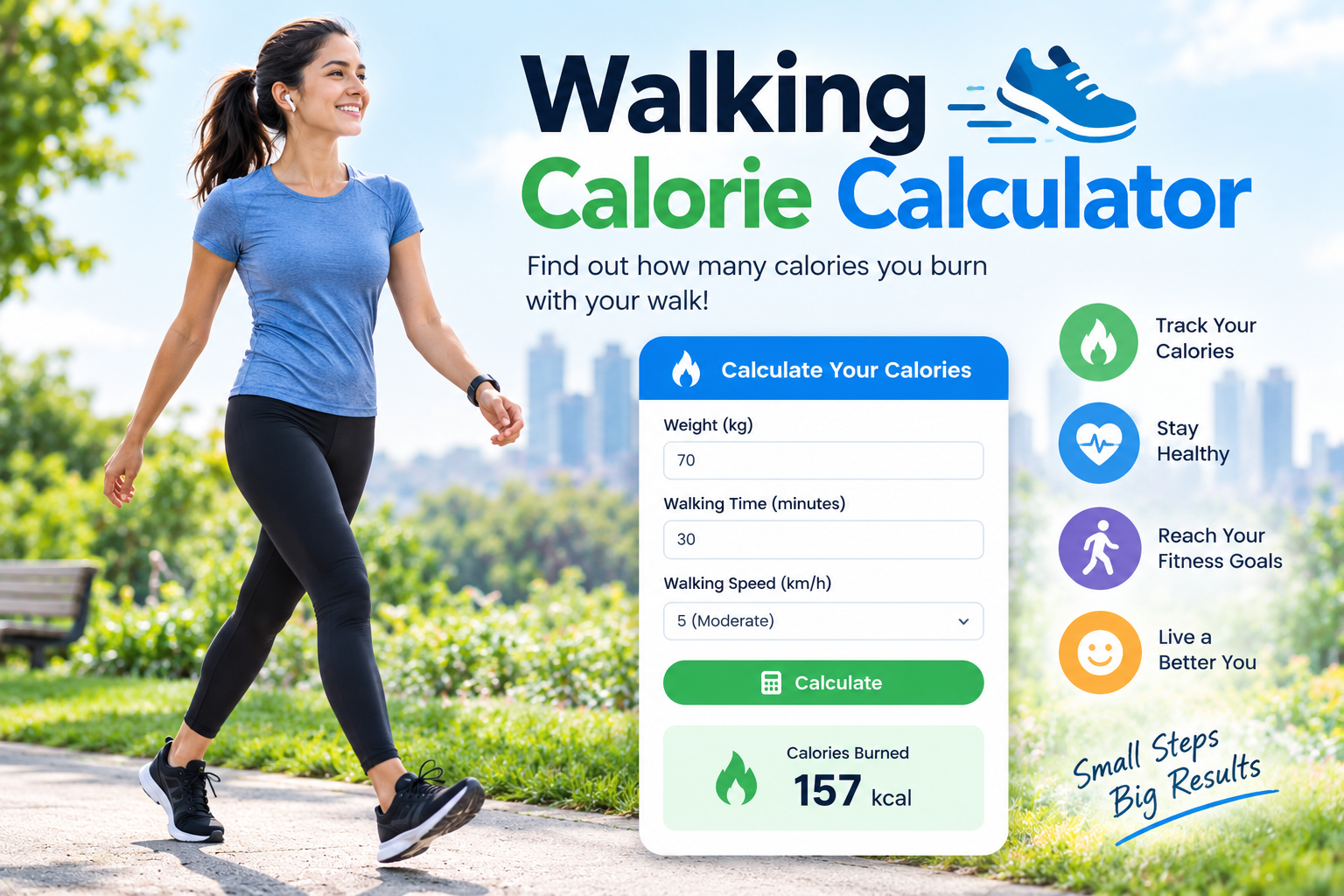
Walking Calories and Steps
Many people track their walking by counting steps.
Steps can be useful, but steps and calories are not the same measurement.
Does 10,000 Steps Burn a Fixed Number of Calories?
No.
There is no single calorie number that applies to everyone who takes 10,000 steps.
The result can vary because of:
- Body weight
- Walking pace
- Stride length
- Terrain
- Total walking time
- Individual differences
Why Steps Alone Cannot Determine Calories
Two people can take the same number of steps but burn different amounts of energy.
One person may walk faster, weigh more, or walk on a different type of terrain.
Therefore, steps alone cannot provide an exact calorie calculation.
Steps vs. Walking Duration
Steps tell you how much movement you completed.
Walking duration tells you how long you were active.
Using both measurements can give you a better understanding of your walking habits.
Walking Distance and Calories Burned
Distance is another popular way to measure walking activity.
Calories Burned Walking 1 Mile
The calories burned during a one-mile walk depend on your body weight, pace, terrain, and other factors.
There is no universal calorie value for one mile.
Calories Burned Walking 2 Miles
Walking two miles generally requires more total activity than walking one mile when the pace and conditions are similar.
However, the exact calorie expenditure still varies between people.
Calories Burned Walking 3 Miles
A three-mile walk can provide a longer period of physical activity.
Your calorie estimate will depend on how quickly you walk and your body weight.
Calories Burned Walking 5 Miles
A five-mile walk usually requires substantially more time than a short walk.
The total calories burned depend on the same factors, including body weight, walking speed, terrain, and duration.
Walking on a Treadmill vs. Walking Outdoors
Walking can be performed indoors or outdoors.
Treadmill Walking
A treadmill allows you to control several factors, including:
- Speed
- Time
- Incline
- Walking conditions
This makes treadmill walking useful for structured workouts.
Outdoor Walking
Outdoor walking can include:
- Sidewalks
- Parks
- Trails
- Hills
- Roads
- Uneven surfaces
Outdoor conditions may change during the walk.
Does Incline Increase Calories Burned?
Walking on an incline generally increases the effort required compared with walking on a flat surface.
If you use a treadmill, increasing the incline can make the activity more challenging.
The calorie estimate will depend on the incline, speed, duration, and individual factors.
Why Your Calorie Estimate May Be Different
You may notice that two calculators or fitness devices show different calorie results.
This is normal.
Fitness Tracker Differences
Smartwatches and fitness trackers may use different methods to estimate calorie expenditure.
Some devices can use information such as heart rate and movement data.
Different Activity Assumptions
Different calculators may use different MET values or activity categories.
A small change in the assumed intensity can change the final result.
Gross and Net Calories
One tool may show gross calories while another may focus on active or net calories.
This can create a difference even when both tools are working correctly.
Individual Differences
No simple online formula can account for every factor that affects energy use.
For this reason, calculator results should be considered estimates.
Is the Walking Calorie Calculator Accurate?
A walking calorie calculator can provide a useful estimate, but it cannot measure your exact calorie expenditure.
Why Is It an Estimate?
The calculator uses mathematical formulas and activity assumptions.
It does not directly measure the amount of oxygen your body uses during your walk.
More advanced testing can measure energy expenditure directly, but this is not practical for everyday walking.
What Can Affect the Result?
The calculator may not fully account for:
- Individual metabolism
- Body composition
- Exact walking technique
- Terrain
- Weather
- Small changes in walking speed
- Fitness level
- Heart rate response
How Should You Use the Result?
Use the result as a practical tracking estimate.
For example, you can use the same calculator to compare your walking sessions over time.
This is more useful than treating one calorie number as a perfectly accurate measurement.
How to Use Calc Tool Pack’s Walking Calorie Calculator
Using a walking calorie calculator should be quick and simple.
Enter Your Weight
Start by entering your body weight.
Make sure you select the correct unit.
Enter Your Walking Duration
Enter the amount of time you spent walking.
For example:
30 minutes
45 minutes
60 minutes
Select Your Walking Pace
Choose the walking pace or activity level that best matches your walk.
Try to select the option that most closely represents your actual activity.
Review Your Result
After entering the required information, the calculator provides an estimated number of calories burned.
You can use this result to track your activity and compare different walking sessions.
For more useful health-related tools, visit the Calc Tool Pack Health Calculators.
Walking Calorie Calculator Examples
Understanding a few examples can make the calculation easier.
Example 1: 70 kg for 30 Minutes
Suppose:
- Weight = 70 kg
- Duration = 30 minutes
- MET = 3.8
Convert 30 minutes into hours:
30 ÷ 60 = 0.5 hours
Now calculate:
3.8 × 70 × 0.5 = 133 calories
Estimated result:
133 calories
Example 2: 75 kg for 45 Minutes
Suppose:
- Weight = 75 kg
- Duration = 45 minutes
- MET = 3.8
45 minutes equals:
45 ÷ 60 = 0.75 hours
Calculation:
3.8 × 75 × 0.75 = 213.75 calories
Estimated result:
Approximately 214 calories
Example 3: 80 kg for 60 Minutes
Suppose:
- Weight = 80 kg
- Duration = 60 minutes
- MET = 4.0
One hour equals one hour.
Calculation:
4.0 × 80 × 1 = 320 calories
Estimated result:
320 calories
These examples are provided to explain the formula. They should not be treated as exact measurements for every person.
Common Walking Calorie Calculation Mistakes
Avoiding common mistakes can help you understand your results more accurately.
Assuming Everyone Burns the Same Calories
People have different body weights and activity levels.
Therefore, the same walking session may produce different calorie estimates for different people.
Ignoring Walking Pace
Walking for the same amount of time does not always mean performing the same amount of activity.
A slow walk and a brisk walk can have different energy demands.
Confusing Steps With Calories
Steps measure movement.
Calories represent energy expenditure.
They are related, but they are not the same thing.
Treating the Result as Exact
An online calorie calculator provides an estimate.
Do not treat the result as a direct measurement of your metabolism.
Tips for Making Your Walking Routine More Effective
Walking becomes easier to maintain when you create a routine that fits your lifestyle.
Increase Walking Time Gradually
If you are not currently active, start with an amount of walking that feels manageable.
You can gradually increase your walking time as your fitness improves.
Choose a Comfortable Pace
Your walking pace should be appropriate for your current fitness level.
A brisk pace can increase intensity, but you do not need to walk as fast as possible to benefit from regular physical activity.
Add Inclines When Appropriate
Once you are comfortable with regular walking, hills or treadmill incline can provide an additional challenge.
Increase intensity gradually rather than making sudden changes.
Track Your Activity
Consider tracking:
- Walking time
- Distance
- Steps
- Pace
- Number of walking sessions
- Estimated calories
Tracking your activity can help you understand your routine and monitor changes over time.
Walking Calorie Calculator vs. Other Health Calculators
Different calculators provide different types of information.
Walking Calorie Calculator
A walking calorie calculator estimates the calories you may burn during a walking session.
Calorie Calculator
A calorie calculator can provide a broader estimate of your daily calorie needs.
BMR Calculator
A BMR calculator estimates the energy your body uses at rest to support basic functions.
BMI Calculator
A BMI calculator uses height and weight to calculate Body Mass Index.
Weight Loss Calculator
A weight-loss calculator can provide estimates related to weight-management goals.
These tools answer different questions, so one calculator cannot replace another.
You can explore the available tools on the Bmi Calculators page.
Health Benefits of Regular Walking
Walking is a simple form of physical activity that can support an active lifestyle.
Regular physical activity can provide several health benefits, including benefits for cardiovascular health, physical function, sleep, and overall well-being.
Walking and Cardiovascular Health
Regular aerobic activity can support cardiovascular health.
Walking is one accessible form of aerobic activity that many people can include in their routine.
Walking and Weight Management
Walking uses energy and can contribute to your total daily physical activity.
When combined with appropriate eating habits and other healthy behaviors, regular physical activity can support weight management.
Walking and Mental Well-Being
Physical activity may also support mood and mental well-being.
A walk can be a simple way to take a break from sitting and add movement to your day.
How Much Walking Should You Do?
There is no single walking schedule that is perfect for everyone.
For general health, adults are commonly advised to aim for at least 150 minutes of moderate-intensity aerobic activity per week, along with muscle-strengthening activities on at least two days per week.
Your personal needs may vary.
Can Walking Be Split Into Short Sessions?
Yes.
You do not always need to complete your walking in one long session.
For example, you could take:
- A 10-minute morning walk
- A 10-minute afternoon walk
- A 10-minute evening walk
Short walking sessions can make it easier to add more movement to a busy day.
What If You Are New to Exercise?
Start slowly and choose an activity level that feels manageable.
Increase your walking time and intensity gradually.
If you have a health condition, injury, or specific exercise restriction, talk with a qualified healthcare professional about an appropriate activity plan.
Walking for Weight Loss: What Should You Know?
Walking can be part of a weight-management plan, but it should not be viewed as the only factor.
Walking Does Not Guarantee Weight Loss
Weight change depends on many factors.
These include:
- Food and beverage intake
- Physical activity
- Daily movement
- Rest
- Individual metabolism
- Long-term habits
Walking can increase physical activity, but the calories shown by a calculator do not guarantee a specific amount of weight loss.
Consistency Is Important
One long walk can be useful, but a consistent routine may be more practical for long-term activity.
Try to focus on habits that you can maintain.
Combine Walking With Healthy Habits
A balanced routine may include:
- Regular walking
- Nutritious meals
- Adequate sleep
- Recovery
- Strength exercises
- Regular activity tracking
The goal should be to build sustainable habits rather than rely on a single calorie number.
Limitations of a Walking Calorie Calculator
Every online calculator has limitations.
It Cannot Measure Exact Energy Expenditure.
The calculator estimates calorie burn using a mathematical formula.
It does not directly measure your metabolism.
Different Tools May Show Different Results
Fitness trackers, watches, apps, and online calculators may use different formulas.
Therefore, their results may not match exactly.
Use the Result as a Guide
The most useful way to use a walking calorie calculator is as a guide for tracking and comparing activity.
Avoid treating the number as a laboratory measurement.
Health and Safety Considerations
Walking is suitable for many people, but your activity should match your health and fitness level.
Start at a Comfortable Level
If you have been inactive, start with manageable walking sessions.
Gradually increase the duration and intensity as you become more comfortable.
When Should You Stop Exercising?
Stop exercising if you experience serious or unexpected symptoms such as:
- Chest pain
- Severe shortness of breath
- Fainting
- Severe dizziness
- Other concerning symptoms
Seek appropriate medical care when needed.
When Should You Talk to a Healthcare Professional?
Consider speaking with a healthcare professional before starting or significantly changing an exercise routine if you have a medical condition, injury, mobility limitation, or other health concern that may affect exercise safety.
This calculator is intended for general information and activity tracking. It is not a medical diagnosis or treatment tool.
Frequently Asked Questions About Walking Calorie Calculators
How many calories does walking burn?
The number of calories burned while walking depends on your body weight, walking pace, duration, terrain, and activity intensity. There is no single calorie value that applies to everyone. A walking calorie calculator uses these factors to provide an estimate.
How many calories does a 30-minute walk burn?
A 30-minute walk can burn different amounts of calories depending on your body weight and walking pace. For example, a 70 kg person walking for 30 minutes at an assumed MET value of 3.8 would burn an estimated 133 calories using the simplified formula. Your actual result may be different.
Is a Walking Calorie Calculator accurate?
A Walking Calorie Calculator provides an estimate rather than an exact measurement. It can be useful for tracking activity, but it cannot account for every individual factor that affects energy expenditure.
Does walking burn calories?
Yes. Walking requires energy, so it contributes to your total daily energy expenditure. The amount depends on your body weight, walking duration, pace, terrain, and other factors.
Does brisk walking burn more calories?
Brisk walking generally requires more energy than slower walking because it has a higher activity intensity. However, the exact calorie difference depends on the person and walking conditions.
How many calories does 10,000 steps burn?
There is no fixed calorie value for 10,000 steps. The result can vary based on body weight, walking pace, stride length, terrain, and walking time. Steps alone cannot determine exact calorie expenditure.
Does walking on a treadmill burn calories?
Yes. Treadmill walking uses energy just like outdoor walking. Your calorie expenditure depends on factors such as body weight, speed, duration, and incline.
Does walking uphill burn more calories?
Walking uphill generally requires more effort than walking on a flat surface. As a result, incline walking can increase energy expenditure when other factors are similar.
Can walking help with weight loss?
Walking can contribute to regular physical activity and increase energy expenditure. However, weight loss depends on overall energy balance, eating habits, activity, and individual factors. Walking alone does not guarantee a specific amount of weight loss.
Should I trust a smartwatch calorie estimate?
A smartwatch can provide a useful estimate, but it is not a perfect measurement. Different devices use different algorithms and data. Online calculators can also provide estimates using body weight, duration, and activity intensity.
Final Thoughts
The Walking Calorie Calculator is a simple way to estimate how many calories you may burn during a walk.
Your result can depend on:
- Body weight
- Walking duration
- Walking pace
- Activity intensity
- Distance
- Terrain
- Incline
Because these factors vary from person to person, the result should be treated as an estimate rather than an exact measurement.
Walking is an accessible form of physical activity that can help you add more movement to your daily routine. Whether you walk for 15 minutes or spend an hour on a treadmill, tracking your activity can help you understand your habits and stay consistent.
For more tools related to health, fitness, and everyday calculations, visit Calc Tool Pack or explore the Health Calculators category.